


Quick Answer: What should I do after a truck accident in Georgia?
After a Georgia truck accident, get medical care, document the crash, preserve evidence, notify your own insurer as required, and avoid giving a recorded statement or signing anything with the trucking company’s insurer before getting legal advice. Georgia gives most injury victims two years to file a lawsuit under O.C.G.A. § 9-3-33. Truck crash claims often move on a faster evidence timeline than standard car accident cases.
In serious truck crashes, the carrier, its insurer, or a contracted investigator may begin looking at the scene within hours of the collision. That is a piece of the process most Georgia truck accident victims do not learn about until the case is already months old.
While the injured driver is dealing with a hospital admission and unfamiliar medical terminology, the carrier’s side may already be photographing the wreck, locating witnesses, and identifying defenses. The pace on the two sides is often very different in the first days.
Understanding the process helps injured people and their families make faster, better-informed decisions.
Call Us Now for a Free Consultation!
Key Takeaways About the Georgia Truck Accident Claim Process
- Motor carriers and their insurers may deploy investigators quickly in serious crashes, creating an evidence timeline that injured victims often need help matching.
- Georgia gives most personal injury victims two years to file a lawsuit under O.C.G.A. § 9-3-33, with shorter ante litem notice deadlines for claims against government entities.
- Georgia follows a modified comparative negligence rule under O.C.G.A. § 51-12-33, meaning a plaintiff generally cannot recover if found 50% or more at fault, and any recovery is reduced by the plaintiff’s percentage of fault.
- Federal Motor Carrier Safety Administration (FMCSA) rules govern commercial trucking and often anchor the negligence theory in a Georgia truck accident claim.
- Litigated truck accident claims frequently take a year or longer to resolve, with catastrophic-injury and contested-liability cases often taking longer.
What Should You Do in the First Days After a Truck Accident in Georgia?
Once you are home from the hospital or stable enough to think clearly, the priority shifts to documentation. That work includes tracking your treatment, preserving records, and limiting contact with the other side’s insurer.
Rushing to give a statement, sign paperwork, or accept a quick settlement in the first week usually favors the trucking company.
Practical steps to take in the first days once you are home:
- Follow every recommended medical appointment and keep copies of visit summaries
- Save the Georgia Uniform Motor Vehicle Accident Report and any citations issued
- Photograph visible injuries at intervals as bruising and swelling develop
- Keep a simple written log of pain levels, missed workdays, and daily limits
- Route trucking-side insurance calls to a truck accident lawyer before speaking
These steps look basic on paper. In a Georgia truck crash file, they often carry more weight than any single piece of evidence introduced later.
How Does the Trucking Company Respond After a Georgia Truck Accident?
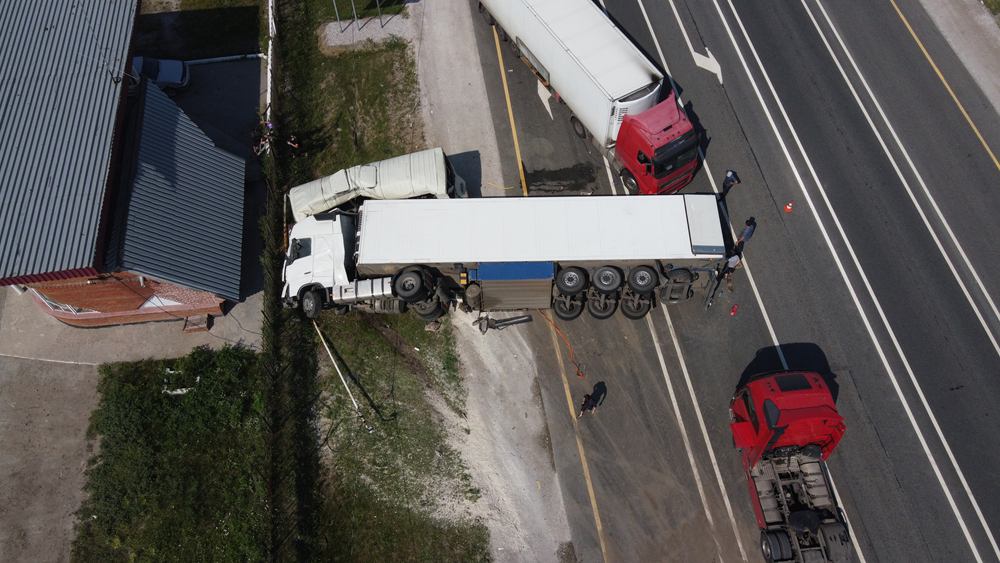 The trucking company’s response to a serious crash is often fast, organized, and defensive. Motor carriers regulated by the FMCSA operate under strict federal rules.
Those rules cover hours-of-service log preservation, internal reporting inside tight time windows, and post-crash drug and alcohol testing when specific conditions under 49 C.F.R. § 382.303 are met.
Alcohol testing must be attempted within 2 hours (stopping after 8 hours if not done), and controlled-substance testing within 32 hours.
That regulatory framework often produces a defense response most injured drivers rarely see. Early moves that may appear on the carrier’s side in a serious crash:
- Deploying a rapid-response investigator or claims adjuster to the scene
- Retaining defense counsel early, sometimes within days of the collision
- Preserving or collecting driver logs, electronic logging device data, and electronic control module data covering vehicle functions such as speed, braking, and throttle where the equipment records them
- Contacting the injured party for a recorded statement under a friendly framing
- Post-crash drug and alcohol testing when the regulatory conditions are met
The pace on the carrier’s side often runs ahead of the injured victim’s ability to respond. That imbalance is the practical reason truck crash cases benefit from early legal involvement.
What Does the Georgia Truck Accident Claim Process Look Like?
The Georgia truck accident claim process moves through predictable stages, from initial documentation through resolution by settlement or trial. Based on our experience, many litigated Georgia truck cases resolve in roughly 12 to 24 months.
Cases involving catastrophic injuries, disputed liability, or multiple defendants often take longer than straightforward files. Outliers exist in both directions.
Categories of evidence that shape a Georgia truck crash claim
Trucking cases pull from evidence categories that rarely appear in standard car accident files. Preserving these records early often decides which theories of liability survive discovery.
- Electronic logging device (ELD) records tracking hours of service, which FMCSA generally requires carriers to retain for six months
- ECM data pulled from the tractor, which may include speed, braking, throttle, and other vehicle functions depending on the equipment
- The driver’s qualification file, training records, and prior violations
- Cargo loading documents and shipping bills of lading
- Post-crash drug and alcohol test results, where FMCSA testing conditions were met
Each of these categories tells a different story, and building the claim around the right one shapes what a jury or claims adjuster sees.
Typical stages of a Georgia truck accident claim
Truck accident claims in Georgia progress through several recognizable phases, each with its own workload and evidence priorities. The ranges below reflect our firm’s experience and are not fixed rules.
| Stage | What Happens | Rough Timeline |
| Investigation | Evidence preservation letters, records requests, medical documentation | Weeks 1 to 12 |
| Demand and negotiation | Written demand to the carrier’s insurer, initial settlement discussions | Months 3 to 9 |
| Filing suit | Complaint filed in the appropriate Georgia court if settlement stalls | Months 6 to 12 |
| Discovery | Depositions, expert reports, document exchange | Months 9 to 18 |
| Mediation or trial | Court-ordered mediation, then trial if the case does not resolve | Months 12 to 24 or longer |
Compensation in a resolved Georgia truck accident case falls across several damage categories. What a specific claim recovers depends on injury severity, available insurance, comparative fault findings, and other case-specific factors.
- Past and future medical costs tied to the crash
- Lost wages and reduced future earning capacity
- Pain, suffering, and loss of enjoyment of life
- Property damage and vehicle replacement costs
- Punitive damages when the conduct meets Georgia’s statutory standard under O.C.G.A. § 51-12-5.1
The full value of a truck accident case often takes months to develop, once the medical picture stabilizes and long-term care needs are documented.
What Deadlines Apply to Georgia Truck Accident Claims?
 Georgia generally gives truck accident victims two years from the crash date to file a personal injury lawsuit under O.C.G.A. § 9-3-33. Wrongful death claims generally run on their own two-year clock from the date of death.
Cases against government entities carry ante litem notice deadlines that attach much earlier—often as short as six months for state entities and sometimes less for cities or counties—and are unforgiving when missed.
Specific accrual rules, tolling provisions, and claim structures should be reviewed individually.
Families and injured drivers who miss deadlines usually do so for a small number of predictable reasons:
- Missing ante litem notice deadlines when a government vehicle was involved
- Assuming O.C.G.A. § 9-3-99 tolling applies without confirming the statute covers the specific claim
- Delaying uninsured motorist notice to the injured party’s own carrier
- Waiting past evidence retention windows for camera footage and dashcam recordings
- Filing suit in the wrong Georgia county and drawing a venue transfer
None of these deadlines wait for the medical picture to stabilize. Early legal involvement often changes the case by month six.
Why We Write About the Georgia Truck Accident Process
McArthur Law Firm has litigated Georgia truck accident cases for 44 years. Our eight attorneys have recovered more than $450 million for injured Georgians and grieving families.
Recent trucking outcomes include verdicts of $20 million and $19 million in Middle Georgia truck crash matters.
Founder Katherine McArthur is Certified as a Truck Accident Law Specialist by the National Board of Trial Advocacy (NBTA), one of a small number of Georgia attorneys currently holding that specialty certification. That credential shapes how our team approaches the claim process from day one.
Writing about the truck accident claim process comes out of decades of watching families make avoidable mistakes in the first weeks after a crash. The most common mistake is treating a truck crash claim like a car crash claim.
Prior results do not guarantee a similar outcome. Every case depends on its own facts and applicable law.
Call Us Now for a Free Consultation!
FAQs for Georgia Truck Accident Claim Process
Do I have to give the trucking company’s insurer a recorded statement?
Generally, you do not have to give the trucking company’s insurer a recorded statement. Doing so early in the process may hurt your claim.
Statements taken in the first days often lock in wording that defense counsel later uses to challenge your injuries, fault, or credibility.
Who pays my medical bills while a Georgia truck accident claim is pending?
Health insurance, MedPay coverage, and out-of-pocket payments usually cover medical bills during a pending Georgia truck accident claim. Georgia does not have a no-fault insurance system.
The trucking company’s insurer typically does not pay medical bills until the case resolves through settlement or judgment.
Can I settle a Georgia truck accident claim without filing a lawsuit?
Yes, many Georgia truck accident claims settle before a lawsuit is filed. Whether pre-suit settlement makes sense depends on liability clarity, injury severity, and the carrier’s initial position.
Filing suit sometimes becomes necessary when the insurer refuses to negotiate reasonably.
Talk to a Georgia Truck Accident Lawyer Before the First 30 Days Pass

Founding Partner
The first 30 days after a Georgia truck accident set the direction for much of what follows. Evidence gets preserved or lost, medical documentation gets built or overlooked, and settlement positions get locked in or kept flexible.
The decisions made in the weeks after the crash often drive the outcome more than the crash facts alone. Call McArthur Law Firm at 478-238-6600 for a free case review with a Georgia truck accident attorney.
Call Us Now for a Free Consultation!
McArthur Law Firm – Main Macon Office
6055 Lakeside Commons Drive, Suite 400
Macon, GA 31210
Phone: 478-238-6600